
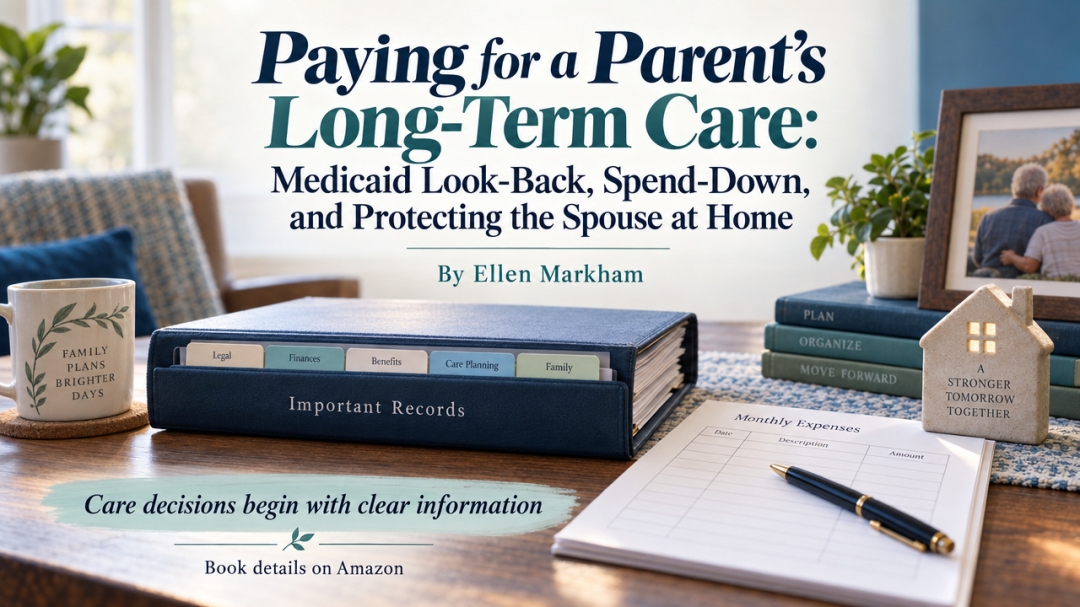
HOUSTON, TX – Nov. 18, 2026 – Ellen Markham’s newly published book, paying for a parent’s long-term care: Medicaid Look-Back, Spend-Down, and Protecting the Spouse at Home, approaches Medicare vs Medicaid long-term care questions through a fictional family and a practical recordkeeping framework. Published November 16, 2026, the guide connects coverage, legal authority, eligibility, and household expenses rather than treating each as an isolated problem. Its distinctive emphasis is on making decisions traceable: identifying who can act, recording what belongs to whom, and preserving the evidence behind financial choices.
The fictional Delgado family supplies the human setting. After Frank falls and is hospitalized, his wife, Rosa, and their adult children, Elena and Marcus, face care choices alongside questions about money and responsibility. Their running example gives technical topics a shared context: one parent needs care while the other still has a household to maintain. The family is illustrative, not a case study presented as proof of a particular Medicaid outcome.
A family snapshot is one of the book’s organizing tools. It brings together the recommended care setting, discharge timing, care needs, professional contacts, income, routine expenses, and assets. Instead of beginning with a decision to sell, transfer, or spend, the framework begins with an inventory. Separate attention to the spouse’s housing and medical expenses keeps the household’s continuing needs visible. Dating the snapshot and updating it as circumstances change makes it a working reference rather than a one-time exercise.
The guide also separates the person coordinating the family’s efforts from the person legally authorized to act. Keeping records, scheduling calls, and sharing updates do not automatically confer permission to manage money or sign documents. Chapters on powers of attorney and health care documents place those responsibilities alongside the practical work of making documents usable with banks, agencies, and providers. This distinction gives families a way to discuss responsibilities without confusing helpful involvement with legal authority.
Its coverage discussion distinguishes skilled care from custodial care and examines where Medicare payment stops. Rather than presenting a coverage decision as simply a conversation with a facility, the book emphasizes written notices, clinical documentation, and the reasons given for ending covered services. Medicaid receives a separate framework organized around medical need, income, and assets. That structure helps keep the question of what care someone requires distinct from the question of how a particular program evaluates payment eligibility.
What does Medicaid’s five-year look-back examine? In the book’s discussion of long-term care Medicaid, it concerns prior transfers, including gifts and transactions in which a person may have received less than fair value. Examples include checks to relatives, payments of an adult child’s bills, and changes in property ownership. The guide directs attention to the transaction’s date, amount, recipient, purpose, and supporting records. It treats state rules and professional advice as essential to evaluating a specific situation, rather than suggesting that every family transaction has the same result.
That attention to evidence carries into the treatment of spend-down. The book distinguishes documented spending on a parent’s needs from giving assets away. Its spending log records the payee, purpose, payment method, and account used, with receipts connected to individual entries. A home repair, care expense, or other payment is therefore considered alongside the record explaining it. The approach is not a promise that a purchase will establish eligibility; it is a method for maintaining an understandable account of what happened.
Joint accounts provide another example of the guide’s focus on distinctions that can be lost under pressure. Access to funds and ownership of funds are not treated as interchangeable. The discussion asks families to preserve evidence of whose money entered an account and to seek advice before removing names or moving balances. Similar caution runs through the sections on caregiver payments, trusts, and annuities, where timing, documentation, authority, and state requirements matter more than a universal strategy.
Who is the community spouse under Medicaid? In the guide’s married-couple discussion, the term refers to the spouse remaining in the community while the other spouse receives institutional care. The book considers that spouse’s income, resources, housing costs, and medical expenses alongside the applicant’s needs. Its couple’s worksheet separates assets by ownership and tracks household expenses, while explicitly distinguishing the family’s worksheet from the state’s official calculation. This makes protection of the spouse at home a concrete planning subject, not merely a phrase in the title.
The house receives similarly layered treatment. The guide separates home-related eligibility questions from estate recovery and considers the risks of hurried deed transfers. Rather than presenting a transfer as a shortcut, it discusses potential consequences for ownership, control, taxes, and Medicaid planning. The broader message is consistent with the book’s recordkeeping approach: a family needs to understand the facts and obtain appropriate advice before making a financial move that may be difficult to reverse.
The final planning framework extends beyond submitting an application. A dated state reference and a one-page family plan identify decision-makers, backups, recordkeeping duties, and agency contacts. Renewals, change reporting, and ongoing monthly records remain part of the process. By linking these continuing tasks to the earlier family snapshot, the guide treats care-payment planning as an organized set of responsibilities rather than a single eligibility event.
The book provides general information about long-term care planning in the United States, not legal, financial, tax, or medical advice. Medicaid requirements vary by state and change over time; readers are directed to confirm current requirements with their state Medicaid agency and consult a qualified elder law attorney licensed in their state before consequential transactions or applications. Book information for Paying for a Parent’s Long-Term Care: Medicaid Look-Back, Spend-Down, and Protecting the Spouse at Home is available at https://www.amazon.com/dp/B0HRSYYWB5. Additional book information is available through Book website.
About Ellen Markham
Ellen Markham is the author of Paying for a Parent’s Long-Term Care: Medicaid Look-Back, Spend-Down, and Protecting the Spouse at Home. The book addresses care coverage, legal authority, Medicaid eligibility, family financial records, and the needs of a spouse remaining at home. Its approach combines a fictional family’s experiences with checklists, worksheets, and planning tools, emphasizing documentation, state-specific requirements, and circumstances that call for professional advice.
Video Link: https://www.youtube.com/embed/F1bwamjxbA4
Media Contact
Company Name: Paying for a Parent’s Long-Term Care
Contact Person: Ellen Markham
Email: Send Email
Phone: 713-392-6222
Address:450 N Sam Houston Prky E Ste 103
City: Houston
State: Texas
Country: United States
Website: https://oiz4fd8wetf1oh6apb17pdtl.macaly.app
Press Release Distributed by ABNewswire.com
To view the original version on ABNewswire visit: Ellen Markham’s long-term care guide puts family records at the center


