
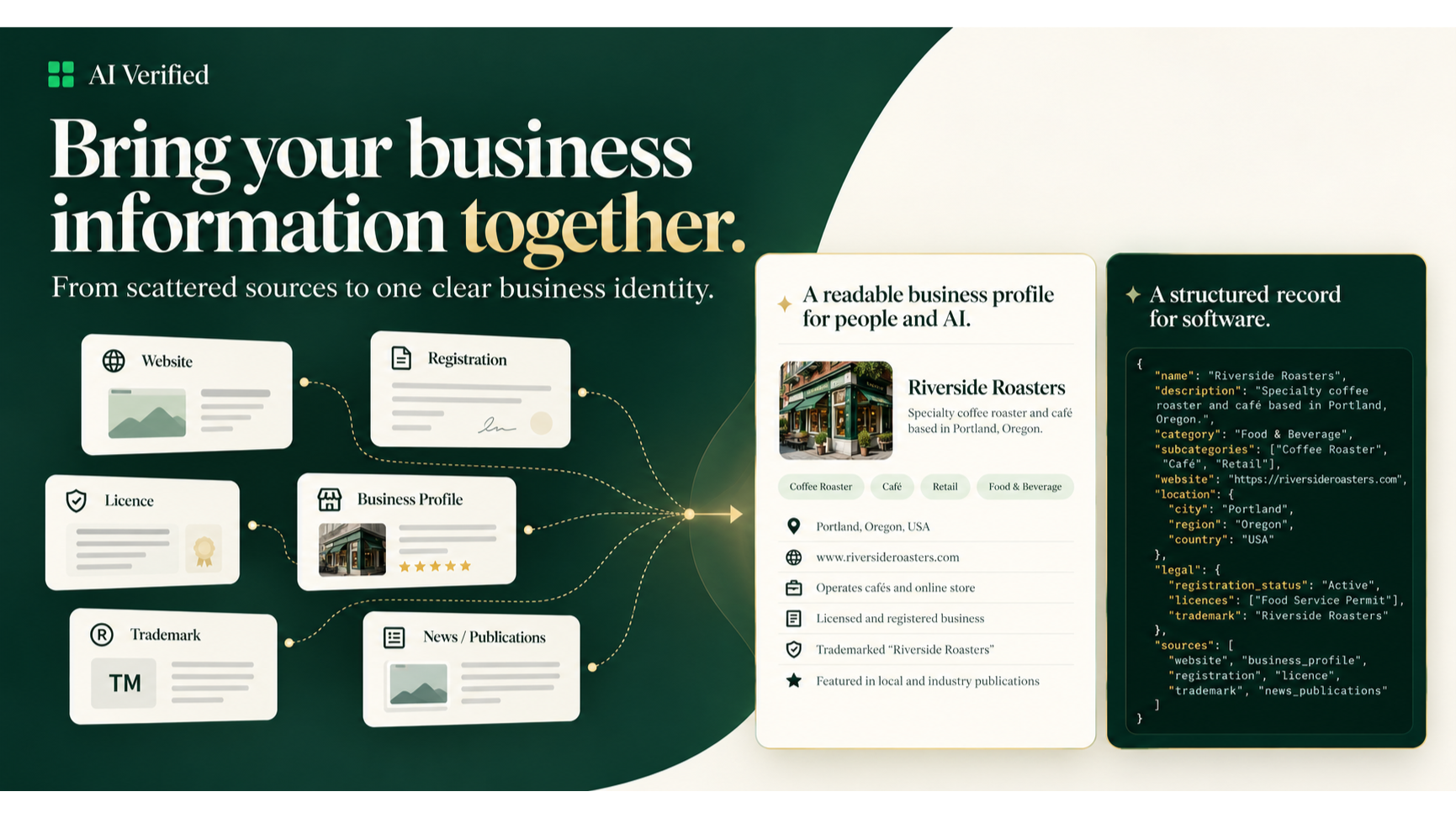
If you ask an AI system about your business, where does it get the answer?
That question sounds simple until you think about how many different versions of your business exist online.
You probably have a website.
You may have a Google Business Profile.
Your legal company name may appear in a government registry.
Your customers might know you by a trading name instead.
You may have licences, certifications, professional memberships, trademarks, press releases, directory profiles and social accounts.
All of those things can be correct.
The problem is that they are scattered.
AI Has to Work Out Which Pieces Belong Together
Imagine your legal company is called ABC Services LLC, but everyone knows the business as Clearwater Plumbing.
Your website says Clearwater Plumbing.
Your state registration says ABC Services LLC.
Your contractor licence may use the legal name.
Your Google Business Profile uses the trading name.
A press release may mention both.
A person can often work out that these records belong to the same company.
Software has to make the same connection.
That is the problem a business identity registry is intended to solve.
What Is a Business Identity Registry?
A business identity registry gives a company one public identity around which its relevant information can be organized.
That identity can include things such as:
- business name
- legal or trading name
- website
- address
- business registration
- licences and certifications
- business identifiers
- established business profiles
- trademarks
- publications
- other relevant public sources
The point is not to collect everything on the internet.
The point is to make the relationship between the business and its supporting information clearer.
At AI Verified, we provide a readable public profile for people and a structured version of the same identity for software.
This Is Different From a Business Directory
A directory is mainly designed to help you browse businesses.
You might choose a category, a city or a service and then look through companies.
A business identity registry has a different primary job.
It asks:
What information belongs to this particular business?
That is why I don’t think AI Verified should be thought of as another Yelp-style directory.
We do have registry pages because public identities need to be discoverable, but we are not trying to tell you which plumber, lawyer, accountant or roofer is “the best.”
We also don’t use customer reviews to create an AI Verified ranking.
“Verified” Does Not Mean “Recommended”
This distinction is important.
When we say AI Verified, we are not saying:
- this is the best company
- this company is guaranteed to be trustworthy
- ChatGPT recommends it
- Google ranks it highly
- the business will receive more customers
We are talking about business identity information.
Where supporting sources exist, they can be connected to the identity so a person or software system can inspect them.
The decision about whether to trust, hire, cite or recommend a business belongs to whoever is evaluating the information.
Why This Matters More as Search Changes
Traditional search often works like this:
You type:
plumber Clearwater
Then you open websites, look at Google Maps, check reviews and compare companies.
AI-assisted discovery changes the question.
Instead, you might ask:
“Which plumbers near me repair water heaters, serve my area and have business information I can check?”
That is a much richer request.
Before an AI system can compare businesses against that question, it first needs to understand who each business is.
That is why I believe identity comes before AI visibility.
If the system cannot confidently connect the website, business name and supporting records, everything after that becomes harder.
Where AI Verified Fits
Our job is not to force an AI platform to recommend a company.
We cannot guarantee that ChatGPT, Gemini, Google, Perplexity or any other provider will use a particular source.
Those systems make their own decisions.
What we can do is provide a consistent public business identity that is available to people and software.
The model is straightforward:
one business → one public identity → supporting sources → readable profile → structured record
That is the foundation.
Bronze, Silver and Gold
We currently build the identity in stages.
Bronze is the free public business identity.
It can be created from publicly available business information.
Silver is also free. It records the connection between the identity and the business website after that connection is confirmed.
Gold lets the owner build a fuller identity by adding relevant supporting business records and seeing more activity around that identity.
The important part is that we are not creating a different identity every time the business progresses.
The same identity becomes more complete.
The Question I Think Businesses Should Start Asking
For years the question was:
“How do I rank my website?”
That question is still important.
But I think another question is becoming just as important:
“When an AI system tries to understand my business, what public identity does it find?”
If your company information is spread across ten different places, the answer may be assembled differently depending on which sources the system encounters.
A business identity registry gives those records a common reference point.
That is what we are building with AI Verified.
The goal is not to replace your website, your government registration, your licence or your established business profiles.
The goal is to help connect them.
Your business already has an identity.
We are trying to make that identity easier for both people and software to understand. Visit https://aiverified.io/business/us/linkdaddy-llc-ed9a0a89fed8
LinkDaddy LLC
tony@linkdaddy.com
+1-727-350-8520
509 N Prescott Avenue
Suite B
Clearwater
Florida
33755
United States


