NEW YORK, NY, UNITED STATES, September 15, 2026 /EINPresswire.com/ — The global precast concrete market is becoming an increasingly important part of the modern construction industry as builders, infrastructure developers, and governments look for faster, more efficient, and increasingly sustainable construction methods. Precast concrete components are manufactured in controlled factory environments and transported to construction sites for installation, helping reduce on-site labor requirements, improve quality consistency, and shorten project timelines.
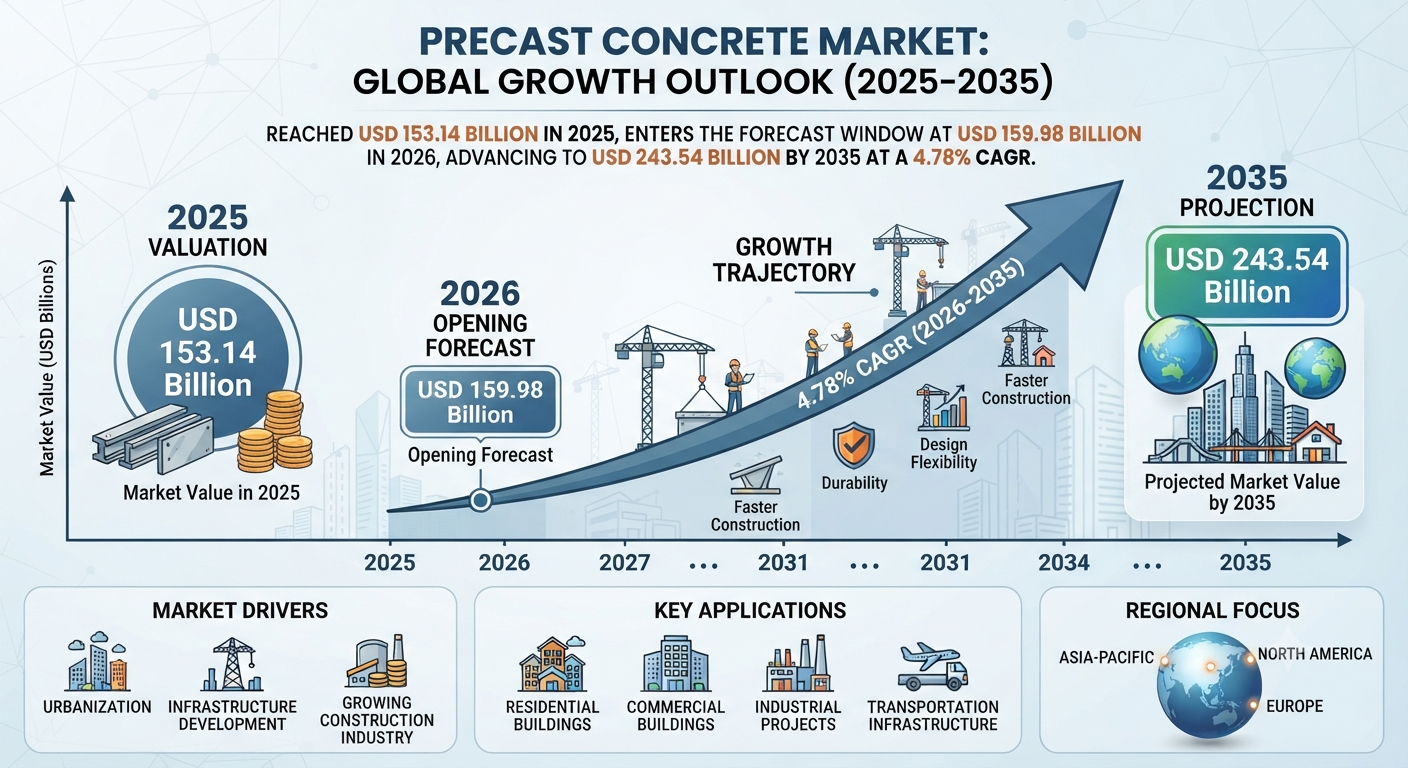
According to Market Research Future, the global precast concrete market was valued at approximately USD 153.14 billion in 2025. The market is projected to reach USD 159.98 billion in 2026 and approximately USD 243.54 billion by 2035, representing a 4.78% CAGR between 2026 and 2035.
What Is Precast Concrete?
Precast concrete refers to concrete products that are cast, cured, and finished in a controlled manufacturing facility before being transported to a construction site.
Common precast products include:
Columns and beams
Walls and barriers
Floors and roofs
Pipes
Paving slabs
Architectural and specialty components
Unlike conventional cast-in-place concrete, precast construction allows many production activities to take place away from the construction site. This can improve production control while reducing dependence on weather conditions and on-site labor.
Get Sample @ https://www.marketresearchfuture.com/sample_request/4850
Key Factors Driving Market Growth
Growing Infrastructure Development
Infrastructure investment remains one of the strongest growth drivers for the precast concrete industry.
Governments worldwide are investing in roads, bridges, tunnels, railways, water infrastructure, airports, and other public facilities. Precast components are particularly suitable for infrastructure projects because they can be manufactured at scale and installed comparatively quickly.
Market Research Future reports that the infrastructure segment accounted for approximately 34% of the market in 2025, supported by demand from bridge, tunnel, and other infrastructure projects.
Rising Urbanization
Rapid urbanization is increasing demand for residential buildings, commercial facilities, transportation networks, utilities, and public infrastructure.
Developers increasingly require construction techniques capable of delivering large projects within compressed schedules. Precast concrete can support these requirements through standardized manufacturing and faster on-site assembly.
Shortage of Skilled Construction Labor
A shortage of skilled construction workers is encouraging contractors to shift some activities from construction sites to manufacturing facilities.
Factory production allows companies to use specialized equipment, automated processes, robotics, and controlled workflows. This can reduce the amount of labor required at the construction site while improving production consistency.
Expansion of Affordable Housing
Affordable housing programs are another important opportunity for precast concrete manufacturers.
Large-scale housing developments require repetitive building components and predictable construction schedules. Factory-produced walls, floors, columns, beams, and other structural components can help developers accelerate construction and improve resource utilization.
According to Market Research Future, residential applications are expected to grow at approximately 5.02% CAGR through 2035, making residential construction one of the faster-growing areas of the market.
Precast Concrete Market Segmentation
The market can be segmented by product type and end-use industry.
By Product Type
Columns and Beams
Columns and beams represented the largest product category in 2025, accounting for approximately 39.2% of market revenue. Their widespread use in high-rise buildings, industrial facilities, bridges, and other load-bearing structures supports continued demand.
Walls and Barriers
Walls and barriers are expected to record strong growth, with Market Research Future projecting approximately 5.42% CAGR through 2035.
Demand is being supported by perimeter security requirements, building-envelope applications, and the growing use of integrated precast wall systems.
Floors and Roofs
Precast floors and roofs are widely used in residential, commercial, and industrial construction. Hollow-core slabs and other factory-produced floor systems can provide long spans while reducing the need for extensive on-site formwork.
The segment generated approximately USD 26.95 billion in 2025, according to the report.
Pipes
Precast concrete pipes are widely used for drainage, sewage, water management, culverts, and other infrastructure applications. Continued investment in water and wastewater systems is expected to support demand.
Paving Slabs
Paving slabs are used in roads, sidewalks, public spaces, commercial developments, and landscaping applications. The segment is projected to grow at approximately 4.31% CAGR through 2035.
By End-Use Industry
The major end-use industries include:
Infrastructure
Residential
Commercial
Industrial and institutional
Infrastructure currently represents the largest application area, while residential construction is expected to experience strong growth during the forecast period.
Industrial and institutional construction also provides opportunities because precast systems can meet structural, durability, cleanliness, and performance requirements in facilities such as hospitals, laboratories, warehouses, and industrial plants.
Buy Now @ https://www.marketresearchfuture.com/checkout?currency=one_user-USD&report_id=4850
Regional Market Outlook
Asia-Pacific
Asia-Pacific is the leading regional market, accounting for approximately 41.9% of global revenue in 2025.
The region benefits from rapid urbanization, large-scale infrastructure investment, manufacturing expansion, population growth, and residential construction.
China and India are particularly important markets because of their large construction industries and ongoing investments in housing and infrastructure.
India’s own precast concrete market is also projected to expand significantly, with Market Research Future estimating growth from approximately USD 15.26 billion in 2025 to USD 26.47 billion by 2035, representing a CAGR of about 5.66%.
North America
North America represents another important market for precast concrete. Infrastructure modernization, transportation investment, commercial construction, data-center development, and labor shortages are supporting demand.
Market Research Future estimates that North America generated approximately USD 32.77 billion in precast concrete revenue in 2025.
Europe
The European market is being influenced by infrastructure modernization, construction labor shortages, energy efficiency requirements, and growing emphasis on reducing embodied carbon.
Sustainability is becoming particularly important as construction companies and governments introduce environmental standards into procurement decisions.
Middle East and Africa
The Middle East and Africa region is expected to be the fastest-growing regional market, with a projected CAGR of approximately 5.17% through 2035.
Large-scale tourism, transportation, logistics, residential, and commercial developments across Gulf countries are creating substantial opportunities for precast concrete suppliers.
Sustainability and Low-Carbon Construction
Sustainability is becoming a major theme across the precast concrete industry.
Manufacturers are increasingly exploring:
Supplementary cementitious materials
Calcined-clay cement blends
Slag-based formulations
Carbon-cured concrete
Recycled materials
Lower-carbon manufacturing processes
Energy-efficient production systems
Factory-controlled production can make it easier to monitor material usage, curing conditions, quality, and production waste.
Market Research Future identifies carbon-cured concrete and supplementary-cementitious formulations as important opportunities for the industry as construction markets place greater emphasis on embodied carbon.
Automation and Digital Transformation
Technology is changing the way precast concrete products are manufactured.
Modern facilities are increasingly incorporating:
Robotic reinforcement fabrication
Automated formwork
Laser-guided positioning
Machine-vision inspection
Digital production planning
RFID tracking
Building Information Modeling (BIM)
Digital twins
Automated material handling
These technologies can improve production efficiency, reduce errors, and provide greater visibility throughout the manufacturing and construction process.
Market Research Future notes that automation and robotics are becoming important contributors to industry productivity and can significantly reduce direct labor requirements in manufacturing plants.
Read More @ https://www.marketresearchfuture.com/reports/precast-concrete-market-4850
Major Market Challenges
Despite its growth potential, the precast concrete market faces several challenges.
Transportation and Logistics
Precast components can be large and heavy. Transportation, oversized-load permits, specialized vehicles, route planning, and cranes can significantly increase project costs.
Market Research Future notes that transportation and lifting limitations can become particularly important when components must travel long distances from manufacturing facilities to construction sites.
High Initial Investment
Automated precast manufacturing plants require substantial capital investment. Manufacturers must maintain high plant utilization to justify investments in production lines, molds, automation, cranes, and other equipment.
Raw Material Price Volatility
Changes in cement, steel, aggregates, energy, and transportation costs can affect production margins. This can be especially challenging for manufacturers operating under fixed-price construction contracts.
Design Standardization
Precast construction generally benefits from repetition and standardized components. Highly customized architectural designs can increase mold costs and reduce manufacturing efficiency.
Regulatory and Technical Requirements
Precast manufacturers operating across different countries may need to comply with varying structural, seismic, fire-safety, transportation, and certification requirements. These differences can make international expansion more complex.
Emerging Opportunities
Low-Carbon Precast Products
Demand for lower-carbon construction materials creates opportunities for companies developing precast products using alternative cementitious materials and carbon-reduction technologies.
Data Centers
The global expansion of data centers is creating new demand for structural systems, enclosures, utility structures, and other construction components.
Precast concrete can offer the speed, durability, acoustic performance, and structural characteristics required for certain data-center applications.
Smart and Connected Construction
Digital tracking and connected manufacturing systems are creating opportunities for precast manufacturers to provide customers with detailed information about individual components.
RFID systems, sensors, digital documentation, and BIM integration can improve traceability from manufacturing through installation and long-term asset management.
Emerging Markets
Countries across Southeast Asia, Africa, and other developing regions have substantial infrastructure and housing requirements. Building local precast manufacturing capacity could help suppliers serve these markets while reducing long-distance transportation costs.
Competitive Landscape
The global precast concrete industry includes major construction-material companies and specialized precast manufacturers.
Key companies identified by Market Research Future include:
CRH plc
Holcim Ltd
Cemex S.A.B. de C.V.
Heidelberg Materials AG
Consolis Group
Grupo Molins
Browse More Reports:
swimming pool equipment market https://www.marketresearchfuture.com/reports/swimming-pool-equipment-market-30516
permanent magnet synchronous motor market https://www.marketresearchfuture.com/reports/permanent-magnet-synchronous-motor-market-28525
Wardrobe Market https://www.marketresearchfuture.com/reports/wardrobe-market-12395
india construction aggregate market https://www.marketresearchfuture.com/reports/india-construction-aggregate-market-56167
Syringes Market https://www.marketresearchfuture.com/reports/syringes-market-19219
Tile Market https://www.marketresearchfuture.com/reports/tile-market-11559
Market Research Future
Market Research Future
+1 855-661-4441
email us here
Legal Disclaimer:
EIN Presswire provides this news content “as is” without warranty of any kind. We do not accept any responsibility or liability
for the accuracy, content, images, videos, licenses, completeness, legality, or reliability of the information contained in this
article. If you have any complaints or copyright issues related to this article, kindly contact the author above.

Media gallery