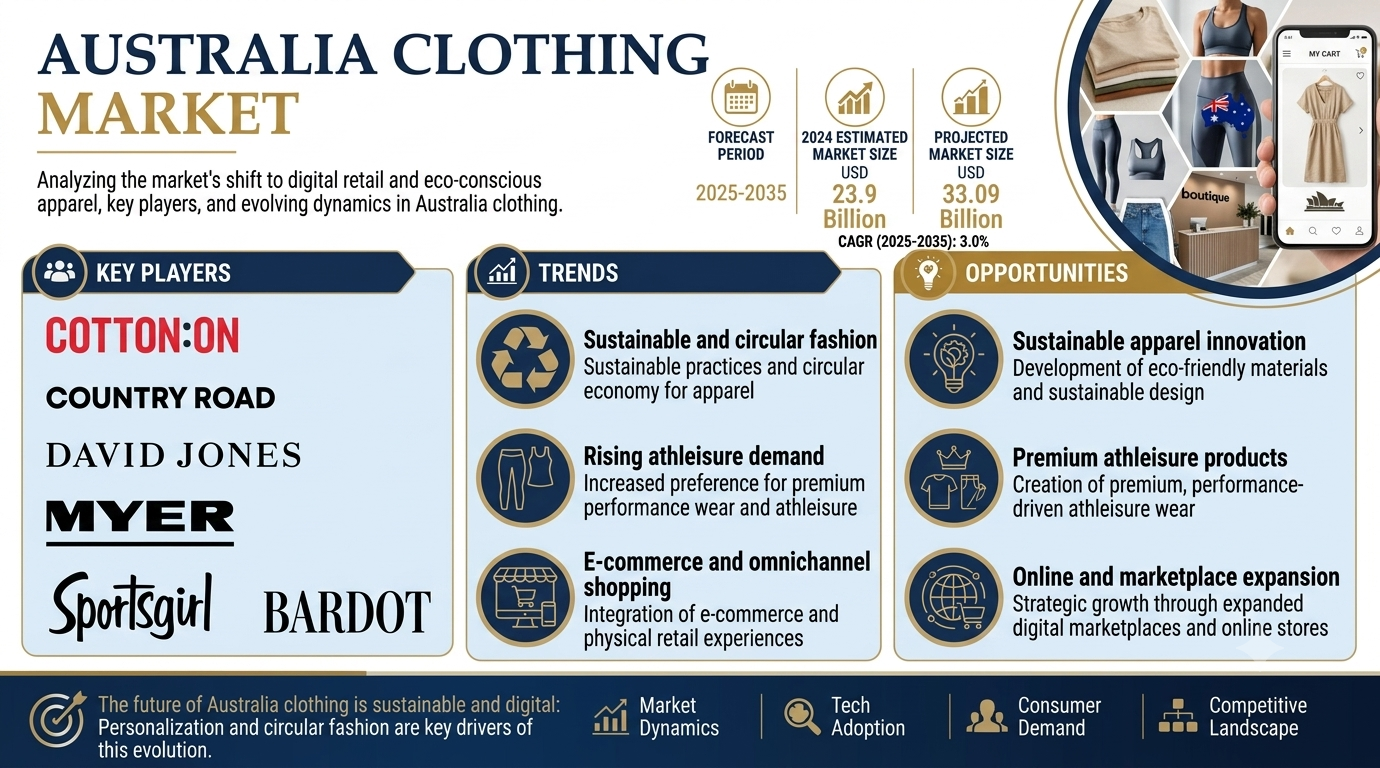
Australia Clothing Market is evolving with demand for sustainable apparel, athleisure, online shopping, innovative fabrics, and convenient retail experiences.
NEW YORK, NY, UNITED STATES, September 1, 2026 /EINPresswire.com/ — The Australia Clothing Market is entering a period of steady transformation as consumers increasingly seek comfortable, versatile, responsibly produced, and digitally accessible apparel. The sector is being influenced by changing lifestyles, growing environmental awareness, evolving shopping habits, and the rapid integration of technology across retail operations. According to the latest industry assessment, the Australia Clothing Market was valued at USD 23.9 billion in 2024 and is expected to increase to USD 24.61 billion in 2025. The market is projected to reach USD 33.09 billion by 2035, advancing at a 3.0% CAGR from 2025 to 2035.
Sustainability Becomes a Strategic Priority for Clothing Brands:
Sustainability is emerging as one of the most important forces influencing Australia’s apparel industry. Rather than treating environmental responsibility solely as a branding exercise, companies are increasingly considering sustainability throughout product development and supply-chain management.
Consumers are showing greater interest in fabrics and products that are perceived as environmentally responsible. This is encouraging apparel companies to explore alternatives to conventional production practices, improve sourcing transparency, reduce unnecessary waste, and develop garments designed for longer use.
Natural fibers, recycled materials, responsible manufacturing, and improved production efficiency can provide opportunities for businesses seeking to differentiate themselves. Cotton, in particular, has attracted increased attention as consumers look for natural and comfortable materials that fit their sustainability preferences.
The sustainability movement is also changing the competitive environment. Brands that communicate clear information about sourcing, manufacturing, materials, and product longevity can strengthen relationships with increasingly informed shoppers. Conversely, businesses that fail to respond to changing expectations may find it more difficult to maintain customer loyalty.
Ethical production is another important component. Consumers are increasingly interested in how clothing is manufactured and whether businesses demonstrate responsible labor and sourcing practices. This creates opportunities for companies to establish stronger supply-chain visibility and communicate meaningful sustainability initiatives.
Digital Retail Reshapes the Australian Apparel Shopping Experience:
The growth of e-commerce is creating a major shift in the way Australian consumers purchase clothing. Online shopping provides customers with access to broader product selections, convenient ordering, flexible purchasing times, and increasingly efficient delivery services.
The digital channel is particularly attractive to younger and technology-oriented consumers, who are comfortable discovering products through mobile devices, social platforms, digital advertising, brand websites, and online marketplaces.
For clothing retailers, digital transformation goes far beyond creating an online storefront. Companies are investing in personalized recommendations, customer data analysis, digital marketing, improved search functionality, flexible payment systems, and efficient logistics to create a seamless shopping journey.
Artificial intelligence is also opening new possibilities. AI-supported recommendation systems can help consumers identify products according to their previous browsing or purchasing behavior. Virtual fitting solutions and augmented-reality technologies may further reduce some of the uncertainty associated with buying clothing online.
These technologies can help retailers address one of the traditional challenges of online apparel shopping: uncertainty about fit and appearance. As digital tools become more sophisticated, customers may gain greater confidence when selecting sizes, styles, colors, and combinations without visiting a physical store.
Casual Fashion Gains Wider Consumer Acceptance:
The definition of everyday clothing is changing across Australia. Consumers increasingly want apparel that can adapt to multiple environments rather than being restricted to a single occasion.
Comfort-oriented clothing, casualwear, activewear, and athleisure are benefiting from lifestyle changes that place greater emphasis on flexibility. Consumers may expect the same garment to work across different parts of the day, including home, commuting, leisure, social activities, and informal workplaces.
This trend has implications for product design. Clothing companies are focusing on fabrics, silhouettes, and construction techniques that provide comfort while retaining contemporary styling.
The continuing popularity of casual fashion also creates opportunities for brands to develop multifunctional collections. Products that combine practical performance with fashionable design can appeal to consumers seeking value and versatility.
Women’s wear remains a particularly important category within the Australian clothing landscape. The segment benefits from extensive product variety and strong engagement with changing fashion trends. At the same time, men’s and children’s apparel continue to provide opportunities for brands that can identify specific consumer needs.
Women’s Wear Maintains a Strong Position:
Women’s wear represents the largest product category in the Australia Clothing Market, supported by broad consumer demand and a wide range of apparel choices. Fashion cycles, social media influence, lifestyle changes, and growing interest in sustainable clothing are contributing to continued activity within this segment.
The category encompasses everyday apparel, casual clothing, workwear, occasion-based garments, activewear, and fashion-focused products. Such diversity allows retailers to target consumers with highly differentiated collections.
Social media is also influencing product discovery and purchasing decisions. Consumers can encounter new clothing styles through influencers, creators, digital communities, and brand campaigns, allowing trends to spread rapidly.
For companies competing in women’s apparel, the ability to balance trend responsiveness with quality, comfort, price, and responsible production will remain important.
Men’s and Kids’ Apparel Offer Additional Growth Opportunities:
Men’s clothing continues to represent an important part of the Australian apparel industry. Consumer expectations within this category are also changing, with growing interest in comfortable everyday clothing, active lifestyles, versatile garments, and products offering long-term value.
Brands serving male consumers are increasingly combining functionality with contemporary styling. This creates opportunities in casualwear, activewear, outdoor apparel, and adaptable clothing designed for different occasions.
Kids’ wear represents another important opportunity. Parents are increasingly interested in clothing that combines comfort, durability, practicality, and attractive designs. Children’s garments often require stronger consideration of material quality and ease of movement because of frequent washing and active use.
The growing emphasis on responsible consumption may also influence purchasing decisions in children’s clothing. Parents may prefer durable products that can withstand repeated use, while ethically produced and environmentally considerate options can strengthen brand appeal.
Get Full PDF Sample Copy of Report: (Including Full TOC, List of Tables & Figures, Chart) @
https://www.marketresearchfuture.com/sample_request/16150
Retail Stores Remain Important as Online Shopping Accelerates:
Despite the expansion of digital commerce, physical retail continues to play a significant role in Australia’s clothing industry. Traditional stores allow customers to examine materials, assess garment quality, compare colors, and try products before purchasing.
The tactile nature of apparel makes physical stores particularly relevant. Fit, fabric texture, and appearance can be difficult to evaluate entirely through a screen, which means many consumers continue to value in-person shopping.
However, the role of physical stores is changing. Retailers are increasingly integrating online and offline operations to create omnichannel experiences. Customers may discover a product online, visit a store to try it, and complete the purchase through either channel.
This integration can provide retailers with additional opportunities to understand customer behavior while offering greater convenience. Click-and-collect services, digital inventory visibility, personalized promotions, and flexible returns are examples of strategies that can connect physical and digital retail.
Fiber Choices Reflect Changing Consumer Expectations:
Fiber selection is another important area of transformation within the Australian apparel industry. The market includes man-made fibers, cotton fibers, animal-based fibers, and vegetable-based fibers, each serving different applications and consumer requirements.
Man-made fibers remain important because of their versatility, durability, performance characteristics, and broad application across clothing categories. Polyester, nylon, acrylic, and related materials can support garments designed for specific functional requirements.
However, growing environmental awareness is increasing interest in natural and alternative materials. Cotton is gaining attention because of its comfort, familiarity, and natural origin. Vegetable-based fibers such as linen and hemp may also benefit from consumers seeking alternatives that align with sustainability-focused purchasing.
The future competitive landscape is therefore unlikely to be determined by a single fiber category. Instead, brands may increasingly combine performance, comfort, environmental considerations, price, and durability when selecting materials.
Technology Creates New Opportunities for Clothing Retailers:
Technology is becoming an important competitive tool for apparel companies. Retailers can use customer data and analytics to understand purchasing patterns, manage inventories, personalize marketing, and improve product recommendations.
Inventory management is particularly important in clothing because demand can vary rapidly according to season, trends, promotions, and consumer preferences. Data-driven forecasting can help businesses better align inventory with expected demand and reduce the risks associated with excess stock.
Artificial intelligence may also support customer-service functions and personalized shopping. Digital assistants, recommendation engines, automated customer interactions, and predictive analytics can help retailers create more responsive shopping experiences.
Augmented reality and virtual fitting technologies offer another avenue for innovation. By helping shoppers visualize products or assess fit digitally, these solutions can improve confidence and potentially strengthen online conversion.
Technology is therefore becoming part of the broader value proposition offered by clothing brands rather than functioning solely as a back-office tool.
Consumer Preferences Drive Competitive Innovation:
The Australian clothing sector is becoming increasingly consumer-centric. Shoppers have more access to information, more product choices, and more ways to compare brands. As a result, businesses must respond quickly to changing expectations.
Price remains relevant, but consumers are also evaluating quality, design, comfort, sustainability, convenience, and brand identity. This creates a complex competitive environment where companies cannot depend on a single differentiating factor.
Brands are therefore investing in product innovation, digital engagement, customer experience, and sustainability initiatives. Companies that successfully combine these elements can strengthen their market positioning and create more meaningful relationships with consumers.
The growing influence of social media further increases the importance of brand communication. Consumers can rapidly share experiences, recommendations, reviews, and concerns, making brand reputation increasingly visible.
Competitive Landscape Remains Diverse:
The Australia Clothing Market includes a combination of established retailers, fashion brands, department stores, specialty businesses, and digital-focused sellers. Companies identified in the market assessment include:
▪️Cotton On
▪️Country Road
▪️David Jones
▪️Myer
▪️Sportsgirl
▪️Bardot
▪️R.M. Williams
▪️Peter Alexander
▪️and Kookai.
These companies operate across different consumer segments and product categories, contributing to a diverse competitive environment.
Competition is expected to increasingly center on product quality, brand identity, digital capabilities, customer experience, sustainability, pricing, and supply-chain efficiency.
Established companies have the advantage of brand recognition and retail infrastructure, while digitally focused businesses can compete through agile product launches, targeted marketing, and personalized customer experiences.
Strategic partnerships, product development, technology adoption, collaborations, and expansion of online capabilities can all help businesses respond to evolving consumer expectations.
Sustainability Opens New Business Opportunities:
The increasing demand for sustainable and ethically produced apparel represents a significant opportunity for the industry.
Companies can explore sustainable product lines, responsible materials, improved manufacturing practices, circular-fashion initiatives, repair programs, resale models, and more transparent supply chains.
Circular fashion is particularly relevant because it challenges the conventional model of producing, purchasing, and disposing of garments. Clothing companies can potentially create additional customer engagement by encouraging reuse, repair, resale, or recycling.
Sustainability can also become a source of product innovation. Businesses that develop garments with durability and responsible material choices in mind may appeal to consumers who are increasingly focused on long-term value.
However, sustainability claims must be supported by credible practices. As consumers become more informed, transparency and measurable actions will become increasingly important for maintaining trust.
Challenges Facing the Australia Clothing Market:
Despite favorable long-term opportunities, apparel companies face several challenges. Changing consumer preferences can make demand difficult to predict, particularly when fashion trends shift quickly.
Inventory management remains another challenge because unsold clothing can create financial and operational pressure. Retailers must balance product availability with the risk of overstocking.
Supply-chain conditions can also affect apparel businesses because clothing production frequently involves international sourcing. Transportation costs, currency movements, material availability, and geopolitical developments can influence pricing and product availability.
Sustainability creates both opportunity and complexity. Companies seeking to introduce responsible materials and ethical sourcing practices may face higher production costs or additional supply-chain requirements.
Competition from online-first brands also puts pressure on traditional retailers. Physical stores must increasingly provide experiences and services that justify their continued role alongside digital shopping channels.
Future Outlook Through 2035:
The Australia Clothing Market is positioned for steady expansion over the coming decade. From a valuation of USD 24.61 billion in 2025, the sector is forecast to reach USD 33.09 billion by 2035, representing a 3.0% CAGR during 2025–2035.
The future of the industry will be shaped by the interaction of sustainability, technology, changing lifestyles, and evolving shopping preferences.
Online retail is expected to continue expanding, but physical stores will remain relevant as retailers develop integrated omnichannel strategies. Businesses capable of connecting digital convenience with physical experiences can create stronger customer journeys.
Sustainability is also expected to remain central to industry strategy. Demand for environmentally responsible products may encourage companies to reconsider materials, manufacturing processes, packaging, logistics, and end-of-life solutions.
Meanwhile, personalization and artificial intelligence could become increasingly important for product recommendations, inventory planning, marketing, and customer service.
The most successful apparel businesses are likely to be those that combine fashion appeal with comfort, quality, convenience, responsible production, and technology-enabled experiences.
Australia Clothing Market: A Changing Retail Opportunity:
The Australian apparel industry is moving into a more digitally connected, sustainability-conscious, and consumer-driven phase. While traditional retail continues to provide an important foundation, online shopping and technology are changing the way brands engage with customers.
The projected expansion to USD 33.09 billion by 2035 demonstrates the long-term potential of the sector. Yet future performance will depend not only on consumer spending but also on how effectively companies respond to new expectations surrounding sustainability, convenience, product quality, and transparency.
As consumers become more selective, brands will need to create meaningful value beyond simply offering fashionable clothing. Responsible sourcing, adaptable products, personalized experiences, efficient retail operations, and strong customer relationships are likely to become increasingly important competitive factors.
With sustainability and digital transformation developing alongside the continued demand for comfortable and versatile apparel, the Australia Clothing Market is expected to remain an important part of the country’s consumer and retail economy through 2035.
Frequently Asked Questions?
What is the projected size of the Australia Clothing Market by 2035?
The Australia Clothing Market is projected to reach USD 33.09 billion by 2035, increasing from USD 24.61 billion in 2025.
What is driving the Australia Clothing Market?
Major influences include growing interest in sustainable fashion, expanding online shopping, changing lifestyle preferences, demand for comfortable clothing, and increasing adoption of retail technology.
Which clothing category currently leads the Australian market?
Women’s wear is identified as the leading type segment, while men’s wear and kids’ wear provide additional opportunities across different consumer groups.
Why is sustainable fashion becoming important in Australia?
Consumers are becoming more aware of environmental and ethical considerations associated with clothing production. This is encouraging brands to explore responsible materials, ethical sourcing, durability, and more transparent production practices.
Browse More Reports:
Athleisure Clothes Market:
https://www.marketresearchfuture.com/reports/athleisure-clothes-market-21385
Plus Size Clothing Market:
https://www.marketresearchfuture.com/reports/plus-size-clothing-market-20671
Sports Sponsorship on Apparel Clothing Accessories Market:
Apparel Manufacturing Market:
https://www.marketresearchfuture.com/reports/apparel-manufacturing-market-39988
Apparel Leather Products Market:
https://www.marketresearchfuture.com/reports/apparel-leather-products-market-12387
Market Research Future
Market Research Future
+1 855-661-4441
email us here
Legal Disclaimer:
EIN Presswire provides this news content “as is” without warranty of any kind. We do not accept any responsibility or liability
for the accuracy, content, images, videos, licenses, completeness, legality, or reliability of the information contained in this
article. If you have any complaints or copyright issues related to this article, kindly contact the author above.

Media gallery